

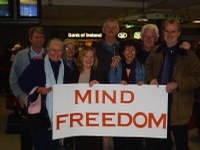
A report from MindFreedom Ireland about giving official testimony at a hearing by the Irish Parliament about psychiatric drug hazards and efficacy.
MindFreedom Ireland speaks out!
O’Mahoney, Miller, Maddock from MindFreedom Ireland Testify Before the Irish Parliament
from Nuria O’Mahony nuriaomahony@eircom.net
Three of our group members testified before the Irish Parliament subcommittee on Adverse Side Effects of Pharmaceuticals this past week. Below is the transcript.
Nuria O’Mahony, Basil Miller, and Mary Maddock are a team not to be trifled with!
About three years ago Nuria’s husband Niel, aged 39, committed suicide. Nuria believes this was drug induced by seroxot (Paxil). She is a nurse from Barcelona, Spain, and has three small children. She is doing all she can to stop the spread of the medical model in Ireland.
~~~~~~
JOINT COMMITTEE ON HEALTH AND CHILDREN
Sub-Committee on the Adverse Side Effects of Pharmaceuticals
http://debates.oireachtas.ie/DDebate.aspx?F=HEP20061017.xml&Ex=All&Page=5
Sub-Committee on the Adverse Side Effects of Pharmaceuticals
The Sub-Committee met at 2.30 p.m. 17 October 2006
MEMBERS PRESENT:
Deputy J. Devins, Senator P. Callanan,+
Deputy L. Twomey, Senator C. Glynn,
Senator M. Henry.
+In the absence of Senator C. Glynn for part of the meeting.
DEPUTY P. CONNOLLY IN THE CHAIR.Information Zoom
Business of Sub-Committee
Chairman: Information Zoom The minutes of the meeting held on 10 October have been circulated. Are they agreed? Agreed. It is proposed to enter private session to discuss correspondence and related matters. Is that agreed? Agreed.
The sub-committee went into private session at 2.32 p.m. and resumed in public session at 2.35 p.m.
Adverse Side Effects of Pharmaceuticals: Presentation.
Chairman: Information Zoom I welcome Ms Nuria O’Mahony, Dr. Michael Corry, Mr. Basil Miller, Ms Mary Maddock and Mr. Gregory White. Before asking Ms O’Mahony to commence the presentation on the adverse side effects of pharmaceuticals, I draw attention to the fact that while members of the sub-committee have absolute privilege, the same privilege does not apply to witnesses appearing before the sub-committee. Members are reminded of the long-standing parliamentary practice to the effect that they should not comment on, criticise or make charges against a person outside the Houses or an official by name or in such a way as to make him or her identifiable.
Ms O’Mahony has asked for and been allocated extended period of time. Normally, a presentation lasts for ten minutes due to pressure on members arising from House business. Some members have notified me that they are under pressure to attend to other predetermined business. Consequently, it will be no slight on her if they are obliged to leave for some time.
Ms Nuria O’Mahony: I thank the sub-committee for allowing me to appear before it. It has been a long journey and I am delighted to attend.
Chairman: There is a slight technical issue with Ms O’Mahony’s slide presentation. Members have received a copy of the presentation available to them. I have looked through it and it is excellent.
Ms O’Mahony: I do not have a copy. I had intended to rely on the slide presentation.
My presentation is entitled, Influence of the Pharmaceutical Industry and the Release of Safety Information on Prescription Drugs: Beneficial or Harmful to Patients in Ireland? All of us, without exception, are affected by this problem. My husband Niall was like a canary going down a mine shaft to forewarn of dangers and harmful gases. I hope his death was not in vain and that the sub-committee will listen to his warning to avoid further unnecessary deaths in Ireland.
I wish to talk about real life and the aftermath of the death of one in 500, my one, Niall, who was aged 39 when he died. He was one of seven children and a devoted father of three children under the age of five. He was a loving husband, a nurse tutor, a sportsman, musician and singer. He lived life to the full and enjoyed every minute of it. I would like to play one of his songs as a tribute to him as a singer and musician.
Chairman: We have technical difficulties. We have discussed this matter and I understand that the song is very touching. We have been briefed on it.
Dr. Michael Corry: I think it might be possible now and it is important that this be heard.
Chairman: I understand. We will listen to the song:
Oh little baby you came and stole my heart
Oh little baby, I was helpless from the start
You captured my heart with your loving smile
I knew that I loved you and that in a while
You little baby would be always by my side
Close to me baby forever on my mind.
Oh little baby I am so in love with you
Oh little baby I will be forever true
I love you, I love you like I have never done
Now that I have found you you are the only one
For me baby I will never let you depart
Do not part from me baby I have given you my heart.
Ms O’Mahony: He was a devoted father to our three beautiful children and a talented singer and musician as the sub-committee has heard. He was also a dedicated mental health professional. Niall died at around 11 a.m. on St. Stephen’s Day 2003 of selective serotonin reuptake inhibitor, SSRI, induced suicide. He hung himself in the garden shed while our three children were alone in their pyjamas in the house. I was at work and not due to come home until around 8.30 p.m. that evening. The breakfast cereal was scattered around the table and no note was left. This was a spur of the moment action caused by drug-induced akathisia or mania; mental turmoil, inner restlessness, massive despair and unbearable turmoil where the only way out of such a black cloud is death. He lost control of his mind for the entire suicide event. He was a great thinker, level-headed, a highly intelligent sensitive man. His death by suicide was against his principles, beliefs and character – and against his important duties as a protective dedicated loving father, which he took very seriously.
His suicide was an explosive automatic reaction in which death must have been seen as a welcome relief from the rapid onset of depression, possibly caused by the SSRIs. He went around his hospital duty office on 23 December 2003 to report back from sickness leave and return to work on 29 December 2003, the date of his death. That is not something a severely depressed person on the verge of suicide might be expected to do, three days before his death. It left me a widow at the age of 33, a single parent with three children under the age of five. I was told he had committed suicide by the Garda, in the accident and emergency department where I work and was left to explain to my children what had happened to Daddy.
My son, fatherless at the age of five, found his father hanging in the shed. He was left alone in the house, in his pyjamas, with his siblings and had to get help for his Daddy and his sisters – our little hero. My daughter, aged three, was left alone in the house in her pyjamas with her siblings while she was waiting for Daddy to come back – on the day of his death. She was the pearl of Daddy’s eyes – our princess. My baby daughter was fatherless at the age of nine months. She was left in her pyjamas alone with her siblings in the house on the day of his death and found crying, by a neighbour, on the kitchen floor. She will never have memories of her father, my baby, Christa. That is our family today, one in five hundred.
The absence of appropriate mild drug treatment for mild depression in our community is contributing to a continuation of such deaths. These unnecessary deaths are very preventible if the required measures are put in place. Such experiences should never be repeated in Ireland, although the regime that gave rise to them continues. Our family’s situation is incomprehensible, since it could have been prevented. My husband definitely was not lucky. The problem arises as serious conditions and common complaints are labelled as medical conditions requiring drug treatment. Runny noses are now serious allergies, PMS has become a psychiatric disorder and hyperactive children have ADD. Every day sexual difficulties are seen to be sexual dysfunction, the natural change of life is a disease of hormone deficiency called menopause. Shyness has become a social anxiety disorder and distracted office workers now have adult ADD. It is not a conspiracy, simply daylight robbery and causes substantial harm. It is plain fraud costing human lives.
With all treatments there is a balance between benefits and harm. For someone who is very sick, the chances of marked improvement may easily outweigh the side effects from a drug. When drugs are being given to healthy people, there is a shift in the balance. If the patient is healthy the likelihood of benefit is smaller. The concern arises that what is being done in terms of the population through drug treatment is causing more harm than benefit.
To put matters into perspective, Dr. Ella Arensman, a member of the National Suicide Research Foundation, who gave evidence about suicide to this committee, said that most people who are depressed do not die by suicide. It is important to bear in mind that the majority who are depressed and who abuse alcohol, do not die by suicide. Mr. Paul Corcoran from the same foundation, said thoughts about suicide and death wishes are relatively common among young people. However, there is a large difference between that and those who go on to engage in suicidal behaviour or who die by suicide.
As regards SSRIs rectifying a chemical imbalance, independent evidence has not confirmed that there is such abnormality in depression. There are no specific anti-depressant drugs. Most of the short-term effects of anti-depressants are shared by many other drugs. Recent meta-analyses show SSRIs do not have clinically meaningful advantages over placebos. There is little evidence to support claims that anti-depressants are more effective in most conditions. Methodological artefacts may account for the small degree of superiority over placebos. Anti-depressants have not been convincingly shown to affect the long-term outcome of depression or suicide rates. Given the doubt about their benefits and concern about their risks, current recommendations for prescribing anti-depressants should be reconsidered.
The medical concept of depression obscures the diversity of problems and experiences that come to be so labelled, while social explanations and interventions have been undervalued. Anti-depressants have progressively become the automatic answer to patients’ depressive symptoms. This automatism induces a passive attitude among general practitioners who see anti-depressants as their only therapeutic strategy and, therefore, do not take into consideration the possibility of developing more specific and individualised treatment plans such as watchful waiting or psychological psychosocial interventions based on scientific evidence. A passive attitude is inevitably induced in patients who receive a message suggesting modifications of thought, mood and conduct can be achieved by pharmacological means only.
Deceptive advertisements are dangerous and pervasive. The public’s trust in doctors’ prescribing decisions might plummet if it understood just how often drug marketers conceal risks from doctors, urge them to prescribe drugs for uses that have not been shown to be safe or effective, and make misleading claims to doctors about the drugs they promote. Deceptive pharmaceutical messages targeting doctors endanger patients by omitting, minimising or misrepresenting the risk associated with certain drugs. Teaching doctors that a drug is safer than it really is causes them to unintentionally endanger patients.
The industry’s weapons of mass seduction are food, flattery and friendship, as well as lots of free samples and gifts. While contacts between companies and doctors tend to lead to less rational prescribing habits, many physicians deny they are being influenced. Human beings have a natural tendency to want to repay kindness. The best way a doctor can do this is by prescribing the drugs retailers are pushing. Doctors exposed to company representatives are more likely to favour drugs over non-drug therapy and to prescribe expensive medications when equally effective but less costly ones are available.
There is a clear gap between recommendations for prescribing and medical practice. Irresponsible prescribing is problematic. Long-term benzodiazepine prescribing is generally unlicensed, but substantial volumes of diazepam continue to be dispensed without charge in the GMS scheme. These drugs play a central role in the lives of Dublin’s most disadvantaged people and may have become, especially for women, a standard means of coping with adversity. In my professional experience, while the dangers have been known for a long time, these drugs continue to be prescribed inappropriately, unnecessarily and irresponsibly. This causes people to become addicts by prescription.
The case of selective serotonin reuptake inhibitors suggests current regulatory practice overstates the benefits and underestimates the risks associated with drugs. Manufacturers’ inappropriate inclusion of suicidal acts in the placebo group created a bias to estimates of the SSRI’s suicide risk in the clinical trials. Regulators’ rigid interpretation of confidence intervals may have delayed warnings of danger of suicidal acts. If the Irish Medicines Board had been rigid in the interpretation of efficacy, the SSRIs would have never been licensed. Regulatory approaches to data on safety and efficacy are asymmetric. For efficacy purposes, trials are seen as assay systems and any positive results outweigh what may be a majority of negative results. In the case of sertraline, although only one of the initial five and five of the first 16 trials showed clearly positive results, the regulatory bodies opted to be guided by indications of possible efficacy from a small subset of trials.
The routine acceptance of companies’ summaries of the results of tests on their drugs as true reflections of the raw data on which they were based is troublesome. Trust is critical in the relationship between regulators and industry. Trust should be based on robust evidence; it should be earned rather than presupposed. Reliance on companies’ summaries is neither sufficient nor appropriate in the absence of effective audit and verification of data that companies provide. The secrecy surrounding this information is also unacceptable.
Long-time FDA safety expert turned whistleblower, Dr. David Graham, told an astonished world in 2004 that the FDA, as currently configured, is incapable of protecting America. In Canada, Dr. Michelle Brill-Edwards, a former regulatory official, summed up a growing sentiment about the watchdogs, saying of Health Canada, “This dog won’t hunt”. The pattern of industry’s influence seriously undermines the public watchdog’s independence. I would say of the Irish Medicines Board watchdog that it does not hunt, bite or bark.
Regarding latrogenic deaths, drug reactions in hospitals only may constitute either the fourth or the sixth leading cause of death behind heart disease, cancer and stroke. No figures for the economic burden of drug-induced illness yet exist in Ireland but it is feared they could be vast amounts. We are going the wrong way.
The unhealthy influence of the pharmaceutical industry has become a global scandal. The full extent of that influence may even be undiscoverable. That influence is fundamentally distorting medical science, corrupting the way medicine is practised and corroding the public’s trust in their doctors.
On the consequences of doing nothing, my family and me are a living example of the devastation caused unnecessarily and this will continue to be the case, day in and day out, for an increasing number of victims in the future. Other consequences are: pain, suffering and death for profit; an unsustainable bill for drug spending in Ireland; the creation of diseases for profit; an increase of dosages and uses of the same drug for profit; the genuinely ill people who need drugs will not be able to afford them and the healthy people who do not need them will be suffering and dying because of them at a bigger price; the unsafe use of drugs; loss of faith and trust in the medical profession; and the increasing medicalisation of society.
What can be done today? My executive report recommendations should be implemented. An independent ombudsman for health in Ireland should be appointed. Transparency, openness and informed consent are fundamental in health care and the pharmaceutical industry should not be exempted from those fundamental needs because of profits. There should be a call for an in-depth investigation into the influence of the pharmaceutical companies on our health service and the consequences of such an influence on our people’s health should be measured.
Our lives begin to end the day we become silent about things that matter. Niall will always be in our hearts. I thank the members for their attention. My delegation will be delighted to answer any questions.
Chairman: I thank Ms O’Mahony for a comprehensive presentation and for keeping within the time guideline. I acknowledge she may have wished to expand some of the points. On behalf of the committee I offer our sympathy on the death of her husband. This is the first time a song was part of a presentation; it is unique in that regard. The booklet will be a good reference guide. When we conclude here we will compile a report and the material provided will be very useful in that regard. Much of it will avoid the necessity to pry into Ms O Mahony’s situation.
Ms O’Mahony said she hopes her husband’s death will not be in vain. We hope that no suicide is in vain. At least people now can say the word “suicide” or that someone has taken their own life. We do not want to deal with the issue of suicide today. As a sub-committee we prepared a report on suicide and made a number of recommendations. I hope Ms O’Mahony will understand, therefore, if we do not refer to the suicide aspect. The ultimate side-effect of any medication is suicide, something this committee has touched on previously. It is one of the issues we will deal with in a report.
The other issue we should mention is the placebo effect to which Ms O’Mahony referred. I read a number of articles which suggested we should discard this medication because it was no good. The sub-committee should not sent that signal. Having worked in the psychiatric field for a number of years, I am aware of the benefits of medication. I have also seen the side effects which are to be considered by the sub-committee. I thank the delegation for its presentation.
Deputy Twomey: I also thank the delegation for its presentation. I worked as a general practitioner before entering politics and still do some work in that field. I can see both sides of the argument. Last week the Irish Pharmaceutical Healthcare Association appeared before the sub-committee. It would dispute much of what MindFreedom Ireland states. The staunch view of most working in this business is that they are helping rather than harming patients.
No non-drug treatment is freely available to patients. Even if they are willing to pay for psychotherapy or counselling, it is difficult to arrange. Structures have not been set up to allow doctors to refer patients for psychotherapy or counselling treatment for mild or moderate depression. Doctors fall back on drugs to treat patients who complain of depression. There are many contradictions in this respect.
The delegation is correct in raising the problems associated with benzodiazepine which was described as “mother’s little helper” in the 1960s and 1970s, providing a temporary lift for mothers under emotional and financial stress. It became the source of a major problem of addiction that is still experienced today. The delegation refers to a report on the abuse of benzodiazepine. In some respects this is indicative of a problem with society that perpetuates the use of benzodiazepine rather than addressing mental health problems, about which very little has been done. Everyone seems happy to use benzodiazepine to treat society’s problems. Doctors are also accused of under-diagnosing and under-treating depression, a charge made across the board.
Regarding the choice between cheap and expensive drugs, doctors are accused of using cheaper rather than expensive drugs to reduce costs in the health service. It is important that we debate this issue. The House of Commons produced an extensive report on it but did not draw any serious conclusions. There seemed to be a variety of views. As the delegation states, many patients do not need anti-depressants but use them as a crutch. Doctors can take different views on this and some rely on medication to address the problem.
The most important issue is whether the drugs are dangerous. If so, is the degree of danger made known to everyone involved? There are problems with every drug. Senator Henry and I discussed the matter of an intracranial bleed caused by aspirin, perhaps the first drug invented.
Representatives of the Irish Medicines Board, which is the regulatory body, will come before the committee next week. I hope to forward much of the material Ms O’Mahony sent to us to the board prior to that so it can consider it. In the context of focusing entirely on the regulatory problems, what can be done?
Chairman: Before Ms O’Mahony responds, Senators Henry and Glynn will comment.
Senator Henry: I sympathise with Ms O’Mahony and her children on their dreadful loss. Ms O’Mahony gave a very worthwhile presentation.
A serious issue exists regarding the lack of “talk” therapies – as opposed to drug therapies – for the treatment of mild to moderate depression. I am old enough to remember wave after wave of pharmaceutical drugs being introduced and remaining in use for perhaps ten years. I refer here to benzothiazide, librium, valium, etc. Eventually, however, many of these drugs are discredited.
In debates in the Houses Members have tried to improve access to what I refer to as talk therapy. One difficulty is that when the new regulations for social workers and paramedical groups were introduced an insufficient number of submissions were received from people who describe themselves as counsellors.
Ms O’Mahony referred to the influence of pharmaceutical companies on the medical profession. At one stage, that influence was huge and one hoped the position had improved. I was struck by the HSE’s requirement that doctors must declare any interest they might have which could affect them in their medical prescribing. I refer, for example, to financial involvements they might have in any firms. In yesterday’s Irish Medical News, Dr. Martin Daly stated that a meeting to instruct GPs in Mayo on developments in primary care, at which a meal was provided, was financed by outside interests and addressed by the HSE expert in primary care, Dr. Sean McGuire. A similar meeting is to take place in Galway in a few weeks. I agree that food, flattery and friendship must be repaid. However, we must persist in retaining a separation between the medical profession and other interests. I thought such a separation was considered essential. I was surprised to discover that the HSE does not have the funds to run such meetings, which are small in scale and attended by only 50 or so people. Such matters must be addressed.
There is another problem in respect of relying on drug companies to provide continuing education and matters of that sort. Companies will promote their products or at least make people feel beholden to them. What Ms O’Mahony had to say in that regard is extremely important.
Ms O’Mahony raised another issue which must be addressed, namely, the increased medicalisation of issues. I read a paper recently in which road rage was described as a medical condition. Road rage is nothing more than extraordinarily bad behaviour while in a car.
The economic burden that results from the prescription of drugs as opposed to what can be achieved through the provision of talk therapy is never considered. There are many doctors who are unhappy because they feel they are obliged to give people prescriptions for drugs. Ms O’Mahony is not, therefore, the only person concerned about this matter.
Mild depression might be a normal response to something that occurred in a person’s life. If bad things happen, it is surely normal to feel sad. That fact does not often appear to enter the equation. Ms O’Mahony may rest assured that we are also extremely concerned about the issues to which she referred. As Deputy Twomey stated, we will address them with the Irish Medicines Board, which has an important role to play.
We must also address them with the Health Service Executive and ask it about having drug companies promote information meetings, primary care or whatever. Although this had been considered to be an extremely bad idea some time ago, it is arising again in this case.
Senator Glynn: I welcome Ms O’Mahony and the rest of the delegation. Like other members, I offer her my sincere and heartfelt sympathy. Regrettably, an offer of sympathy always comes after events happen and unfortunately it is all members can do.
Undoubtedly, our society has developed to the point where it has pills for nearly all ills. Some time ago, the health care unit of the Department of Health and Children broadcast an advertisement to the effect that one often did not need to take medication. While I forget the exact terminology used, the point was that the advice of one’s doctor could be equally as good.
However, society assumes there is a pill for every ill, regardless of whether this is the case. For example, people suggest taking five milligrams of valium or diazepam if one is going on a flight, for an interview or if one has a pain in one’s big toe. Social support structures, such as the family, are often not employed to their optimal value or effect. In many circumstances, the family may be cast in the role of, and can often become, the therapeutic team. Support is extremely important and can come from that source. While people who live on their own can have a difficulty with social isolation, which can of itself be a problem, good neighbours, doctors and friends can often fulfil that role.
Psychotherapy is very important. As the Chairman, who spent many years in the psychiatric services will be aware, it has been employed to good effect. This was certainly the case in my time. Nurses could sit down and talk with people, rather than responding to patients’ request to ask the doctor to put them on this, that or the other. Activation or motivation of the individual, especially in the hospital setting, can be extremely important to ensure that the person is occupied. However, while we could talk in this vein all day, it all comes back to our development into a society that is overly dependent on drugs. I refer to prescribed drugs, as it is unnecessary to mention the other kind because everyone is aware of their adverse effects. It is important to highlight the existence of alternatives, such as good advice and healthy eating. In many respects, the old saying that we are what we eat also has a role.
While Ms O’Mahony’s presentation has a particular relevance, I also agree with the Chairman – I concur up to a point with both contributions – that certain medications have proven to be extremely beneficial in many cases involving those who suffer from depression. Do the witnesses still approve of the continued use of electroconvulsive therapy in the treatment of depression?
Dr. Corry: I am unsure of the protocol. How long can I speak?
Chairman: We are trying to keep it as short as possible. While members had hoped the total presentation would be concluded within 40 minutes, we have extended it by 15 minutes. We want to give as much time as possible. Dr. Corry will note that members have referred to the fact that they have discussed this excellent report in some detail and will make use of it. Hence, while I do not wish to set a particular time, Dr. Corry should be as brief as possible.
Dr. Corry: I will be very brief. Am I permitted to hand some material to the members?
Chairman: We would appreciate that and will take all material on board.
Dr. Corry: I wish to read a human story from a former patient of mine who wrote a long letter to me last week informing me as to the risks and dangers to elderly patients who were taking alanzapine, which are known as apraxa. In the letter she said:
My son Christopher was arrested for drink-driving. No one was injured, thank God, but he was extremely upset about the event. He was afraid of losing his job as a trainee stockbroker and his driving licence. He raced down to his GP and asked for prozac. No problem, he got it. Six weeks later he hung himself in Dalkey quarry. I know he was never depressed in his entire life. He had a world ranking in tennis and a girlfriend he wanted to marry.
I have worked with many families in situations not unlike that described by Ms O’Mahony. The inhibition leading to suicide seems to occur in somewhere between one in 500 and one in 1,000 people. There is no way the makers of anti-depressants will put a warning of risk of suicide on the patient information leaflet. I have discussed this with Ms O’Mahony and we have made a documentary film about her experiences and those of her husband.
Chairman: That is something the sub-committee will address and would like to see change. We do not wish to see the situation relating to warnings on patient information leaflets continue.
Dr. Corry: I find the lack of information extraordinary. I am running a conference in the Burlington Hotel, Dublin, this Saturday called “Healing depression without drugs or electric shocks”. I will give the members of the sub-committee a brochure. We have invited Peter Breggin, psychiatrist, author of Toxic Psychiatry: Talking Back to Prozac who is the only psychiatrist I know waging war on the use of Ritalin by children because he sees the link between it and addiction in adult life.
I sought information and actual figures on the numbers of adolescents and children prescribed anti-depressant medication and Ritalin. I got no information from the Irish Medicines Board. They told me they were not being dismissive but did not have the figures. I contacted the Health Research Board and spoke to Dr. Dermot Walsh, who was quoted two weeks ago in The Irish Times health supplement, about the link between suicide and anti-depressant medication. He told me he sees a direct correlation between the rise of suicide and the rise in the use of anti-depressant medication. I share that view with him.
Chairman: Is he the former Inspector of Mental Hospitals?
Dr. Corry: He is.
Chairman: I have never seen him refer to those views in any of his annual reports. This is a serious issue.
Ms O’Mahony: I gave Deputy Twomey a copy of the “Primetime” programme in which Dr. Walsh expresses those opinions on television.
Dr. Corry: He was quoted on the matter two weeks ago in The Irish Times health supplement.
Chairman: I wish Mr. Walsh had stated that when he was chairman of the Mental Health Commission.
Dr. Corry: I know Dermot Walsh and he is tricky but he made the statement two weeks ago in The Irish Times health supplement.
Senator Henry: Could Dr. Corry repeat himself. Unfortunately, I have tinnitus.
Dr. Corry: I am very sorry. I pointed out that I could not get information relating to the use of anti-depressants in adolescents.
Chairman: Dr. Corry is suggesting the Inspector of Mental Hospitals knew this information, completed an annual report while in the post and did not put it in the general domain.
Senator Henry: What information are we discussing?
Dr. Corry: I was trying get information relating to the number of adolescents using anti-depressant medication so that I could give accurate figures at the forthcoming conference. I rang the Health Service Executive, HSE, the Irish Medicines Board and the Health Research Board and could not get any figures. Dr. Dermot Walsh could not provide figures either, but reminded me of the quote he made in The Irish Times health supplement stating that he correlates the rise in suicide with the rise in the use of anti-depressant medication.
The General Medical Services, GMS, appeared to be the only holder of information on the number of people on medication in the country. I was told to e-mail Mr. Peter Burke, which I did, and I am still waiting for a reply. It was a very polite e-mail. I am a consultant psychiatrist running a conference on 21 October. We would like to have accurate figures on numbers of adolescents and children who are prescribed antidepressant medication, also figures on the prescription of Ritalin and other stimulants. If any member of the committee would like to attend the conference as a guest, he or she may contact my secretary. The committee has the phone number. I would appreciate this information as soon as possible.
We cannot find out exactly how many people are being prescribed medication. The figures I have indicate that some 500,000 in this country are taking antidepressant medication. I draw the committee’s attention to what I have written. It is simple, but very important. I wrote to the effect that I would like to focus on two areas, first, the treasure trove of information that could be accessed for research and auditing purposes through the data processing of prescriptions. Every doctor has a medical registration number from the Medical Council. In addition to the name and address of the patient it is important that this number appears on the prescription, along with the date of birth and gender of each patient and his or her occupation and pregnancy status, where relevant. This is really important, because if we had this information we would now know what is happening. I was on a radio show yesterday afternoon and a woman rang up to say she was five months pregnant, attending a psychiatrist and wanted to come off medication. She had been put on medication because of panic and while she wanted to come off it, the psychiatrist kept increasing it.
I have worked as an obstetrician and did neonatal medicine. We know the effects of tobacco and alcohol on the foetus. The drug companies are against the use of antidepressant medication during pregnancy and also during lactation, so that there is a good deal of nonsense going on. We need to know the pregnancy status and whether the patient is breast-feeding. We need to know the hospital status of the patient, whether he or she is an inpatient or an outpatient. There is a black hole when it comes to finding out the numbers of pills being prescribed in psychiatric hospitals – a complete black hole. I worked in St. Brendan’s Hospital for years and I could never even find out from the pharmacists who worked there exactly how many drugs were being prescribed. On the recording that the prescribing doctor is aware of all medications that a patient is taking and of the possible adverse reactions between them, many consultants come to me and they do not know some of the side-effects of medication they may prescribe. I am a consultant psychiatrist and a consultant physician. I work in Clane hospital. I do a great deal of work with a great many people. They ask me whether it is safe to prescribe something because the patient in question is on a cocktail of medication.
Another point relates to the recording that the prescribing doctor has advised the patient not to drive while taking psychotropic medication which causes drowsiness. Recently a patient asked me to reduce her medication because she had been involved in a minor road traffic accident. Some patients will not get out of bed and come to see a doctor before noon, because they are on so much medication. We all know that as prescribing doctors. The most important point is the reporting of adverse drug reaction. I have to phone the Irish Medicines Board for them to send out cards to me so that I can report an adverse drug reaction. These adverse drug reaction cards should be available to the public in pharmacies. It is a question of responsibility for the self and self-care. Why cannot I, as the consumer of a product, enter a pharmacy to make my side-effects known on an adverse drug reaction form? Such forms should be made available to general practitioners, also.
Does Deputy Twomey, as a general practitioner, have an adverse drug reaction form on his desk?
Deputy Twomey: I do.
Dr. Corry: However, he would have had to phone the HSE for them.
Deputy Twomey: That is correct.
Chairman: We should not personalise the issue.
Dr. Corry: Time is precious and these points are really important. I received a “Dear Doctor” letter on 8 March 2004. Unfortunately, I do not have a copy, but I recorded it in my book. It informed me as to the risks and dangers to elderly patients who were taking alanzapine, better known as zyprexa. It said that while taking alanzapine, elderly patients with dementia may suffer stroke, pneumonia, urinary incontinence, falls or have trouble walking. Some fatal cases have been reported in this group of patients. On 1 December 2005, the New England Journal of Medicine published an extensive study involving 9,000 elderly patients who were given anti-psychotic medication, and 13,000 who were given atypical anti-psychotic medication. After 180 days, 17.9% of those using the conventional agents died. This compared with 14.6% of those using atypical anti-psychotic medications. Does the committee have those figures?
Chairman: Yes, I have the figures, but I would appreciate a copy of the book to which you refer.
Dr. Corry: Almost 18% died. It is staggering stuff. If alanzapine was a car, it would be taken off the market. This is a disgrace.
I emphasize the point that depression is not a disease rather it is an emotional response to a setback. I have worked as a psychiatrist for 30 years. I have degrees in obstetrics and paediatrics. I have worked in Africa as a surgeon. I know what good and bad sciences are. The science that has taken place in psychiatry is Humpty Dumpty science. There is no scholarship in psychiatry. What has gone on in the field is absolutely appalling. We must face up to the fact the psychiatrists are medicalising life problems because they do not have the necessary qualifications. They go into practice straight from medical school and treat people coming through their doors as if they have a chemical imbalance, or as if there is something biologically wrong with them. It is complete nonsense. They have no training in counselling or psychotherapy.
I have sought figures from the Irish Medical Council, and the best I can get is that 2% to 3% of psychiatrists have actual counselling and psychotherapy qualifications. I know this because I did a membership degree in psychotherapy and know how many of my colleagues are qualified with such degrees. Even though I am registered as having done a higher qualification in psychotherapy, the medical council could not give me the figures. We need to know these figures. We must draw a distinction between psychiatrists who will offer patients drugs, and ones who will offer patients psychotherapy.
Chairman: There are a couple of issues here, and I accept that what you are saying is relevant to the overall scheme of depression.
Dr. Corry: What is in this letter is important.
Chairman: We will take this on board. It is an excellent letter. It is very logical—–
Dr. Corry: This is not rocket science. I need to be able to pick up the phone and find out how many patients here are on ritalin.
Chairman: I accept that.
Dr. Corry: I also need to know the age groups. This is a simple outline.
Chairman: We will certainly take it on board when writing our report. We will tie this into our recommendations. We have discussed the material that your organisation has submitted and we feel it is top class. Regrettably, we are time restricted today.
Ms O’Mahony: I wish to clarify something. I sent Deputy Twomey a great deal of material and wonder if the committee has shared in this information. I sent copies of letters to the Irish Medicines Board and other research material.
Deputy Twomey: Is that the material sent to the committee?
Ms O’Mahony: I submitted several letters. I also have a letter from the HSE where I queried the number of people taking certain drugs but could not get accurate figures.
Deputy Twomey: The whole committee may not necessarily have seen those letters. However, any material sent to the committee would have been referred to the IMB.
Senator Henry: Dr. Corry will be aware that I have quoted him in the Seanad. I am sympathetic to what he has said today. We have a serious problem with people thinking there is a pill for every ill. They have been brought up to think this way and are not told about the side effects.
Dr. Corry: The real problem is that if we are saying emotional problems are diseases, then there is no need to understand or give meaning. We must invest in mental health education that starts in school. There is no reason a child of eight to 11 years of age would not be considered emotionally intelligent. These children know how to handle fear, setbacks and anger. Emotional intelligence can be taught but there is no room to do so if the message is that psychological distress is a disease for which the treatment is a pill.
Senator Henry: Those affected by the problem are distressed, not depressed. The material provided by the delegation is extremely useful. It is bad not to be able to find data.
Dr. Corry: I could not find data anywhere.
Senator Henry: With data available to it, the sub-committee can make a positive effort to have action taken.
Dr. Corry: We need to know the cost of anti-depressant medication. Data show the annual cost to be between ?400 million and ?500 million, hundreds of millions of euro that could be spent on education.
Senator Henry: We must find a way to address the general public on this issue so that people no longer believe it is possible to have happy pills dispensed to them to fix their social problems.
Chairman: Psychiatric medication is frequently prescribed and has a number of side effects. We must address the tendency of drug companies to view every condition as a disease. In general medicine, for example, doctors are reluctant to tell patients they need to make life changes to avoid dispensing medication. Vested interests are at work and a relationship exists between the drug companies, journals and doctors. Moreover, many people do not ask questions because they have busy lifestyles.
We must use our time more effectively, for example, by listening and talking more to patients. I am not aware if Dr. Corry has prescribed drugs but there may be occasions when a person needs prescription drugs to help him or her through a particular difficult time.
Dr. Corry: The analogy I draw here is that of a person who is awakened after having a triple bypass operation to be told that for financial reasons only one coronary artery had been done. It is a disgrace that the well-being of individuals is ignored with the excuse that insufficient funds are available to do counselling and psychotherapy. How much did this building cost? We know that billions of euro are being poured down the drain. Everybody should have the right to psychotherapy if it is indicated.
Chairman: I accept that point.
Deputy Twomey: How many of those who have depression should take anti-depressant drugs?
Dr. Corry: Deputy Twomey can answer that question because he probably prescribes. I do not prescribe any anti-depressants.
Deputy Twomey: I am not criticising Dr. Corry. I was educated to believe that mild and moderate depression is as well suited to counselling and psychotherapy as any form of drug treatment, whereas severe depression needs—–
Dr. Corry: Severe depression is like a swimming pool. It has a shallow and deep end. The worst kinds of depression I have seen usually arise from grief, sexual abuse or bullying where a person has been crushed. The individuals in question need psychotherapy more than ever.
Do anti-depressants help? As Deputy Twomey is aware, anti-depressants work as a psychic energiser. They are no better than amphetamines. A much more honest approach was taken in the old days when people were told they were being given a lift and prescribed an amphetamine. If they could not sleep at night as a result, they were told to take a sleeping pill, a barbiturate. That was the approach in the days of Marilyn Monroe.
The wrong messages are being given with anti-depressant medication. People are told they have a chemical imbalance and that there is chemistry to love, anger and sadness. The drug companies are having a field day promoting the idea of serotonin imbalances, which is morally and ethically wrong. I will see the day when doctors are sued for prescribing medication and giving electric shock treatment for a condition that is not a disease but an emotion.
The book I wrote, Depression – an Emotion, not a Disease, is a bestseller because people know it is a lie to treat depression as a disease. I have brought brochures on Dr. Peter Breggin’s forthcoming speaking visit to Dublin. Members should attend this extraordinary conference because Dr. Breggin is the most important psychiatrist in the world and an expert in this whole area.
Chairmen: Is there any place for medication in the treatment of depression? Does Dr. Corry see any use for it?
Dr. Corry: Personally, no.
Chairman: What about medication in the treatment of severe depression?
Dr. Corry: I do not know what the Chairman means by “severe depression”.
Chairman: Where people are not functioning properly, not attending work—–
Dr. Corry: The reason it has become severe is because they have been on medication for years.
Chairman: So Dr. Corry sees no role for medication in the treatment of depression?
Dr. Corry: I ask the Chairman to hear me out. They have already been on medication for years, and that is why their depression is severe. That the medication has not worked is the justification for giving people electric shock treatment. How can medication cure sexual abuse?
Chairman: It cannot. It takes counselling and therapy.
Dr. Corry: How can medication cure a dysfunctional marriage or unemployment and financial problems? We medicalise these problems, justify depression as a disease—–
Chairman: Bipolar depression—–
Dr. Corry: I ask that the Chairman hear me out. When the pills do not work and the depression becomes severe, we administer electric shock treatment. Some 850 souls in this country receive electric shock treatment and it causes brain damage. It works because it erases memory.
Chairman: So Dr. Corry sees no case for prescribing medication?
Dr. Corry: It is addictive, causes many side effects, is associated with suicide, causes sexual dysfunction, including impotence, and breaks up relationships because a person taking medication loses empathy and love for his or her spouse. It has been proven that when so-called serotonin rises as a result of medication, it suppresses oxytocin and prolactin, the “love” hormone in a mother and thereby even the bonding between a mother and a child. So these drugs work against love and empathy. They suppress oxytocin. I have a degree in medical science. This is serious.
Ms Mary Maddock: I was on them. I know it is true.
Ms O’Mahony: The issue is also about pharmaceutical education. Doctors receive all their post-graduate education from the pharmaceutical industry. Some 50% of Irish GPs rely on the pharmaceutical industry as the primary source of information on drugs. That was reported on “Prime Time”. Some 75% of GPs are visited by reps several times a week and most doctors feel the information they receive is quite objective. That is dangerous.
Senator Glynn: I agree with Dr. Corry on tackling the problem at school level and the promotion of a positive attitude to their own mental health among young people. That is important. As the Chairman said, what is being done for diabetics is reactionary—–
Dr. Corry: Some 200,000 people in this country have diabetes because of bad eating habits.
Senator Glynn: And those are only the ones we know of.
Dr. Corry: Another 200,000 are on the way.
Senator Glynn: Our actions are mainly reactive. We should engage in more pro-active measures to prevent diabetes. I agree with Dr. Corry’s view that there is a great need to promote mental health among young people, beginning at school level. We have developed into a society that wants a pill for every ill.
Ms Maddock: I suggest another pro-active way of dealing with it. All the good forms of therapy, not just talking therapies, should be encouraged. The Government should provide some financial aid to allow people to go to places such as leisure centres. The Government gives financial aid for people to get drugs. People cannot afford to go to many of these places.
Mr. Basil Miller: The term “person-centred” has not been used yet. The response to a person who manifests depression or any such ailment should be person-centred. Our society has a top-down bias. I have corresponded with Senator Henry on this. Philosophically we have a problem that our response to a psychological or physiological problem has a top-down bias – doctor knows best.
Over the past 100 years, the voice of the patient or, as we say in psychotherapy, the client, has been muted. As doctors, I presume members of the committee have read Faust, which is a prediction or prognostication of what is happening today. It is an extension of what is happening today. A person only needs his or her immune system to be healthy. There is a codependency contract in our society which tells people that society, doctors and pharmaceutical companies know best. The emphasis is not on the individual, whether he or she is a child or adult. Our children are following the example of adults in respect of medication. For ten years, I have been engaged in work similar to that carried out by Dr. Corry. I am a former policeman and have asked the august bodies to make a connection between licit and illicit drugs because there is a very strong connection between illegal and legal drugs. There is no social or psychological hiatus between addiction to illegal drugs and addiction to legal drugs. We must wake up to the fact that addiction to legal drugs has reached epidemic proportions. There is a clear relationship between the prescription of drugs and the illicit taking of drugs.
Chairman: I thank the delegation for its presentation. We could debate this matter at some length if we had the time. The committee will no doubt refer to this meeting as an exceptionally useful session when it goes into private session. The material we have received from the delegation is very useful. I regret that it appears that we were forced to shorten the meeting but it was very useful. We should remember that possibly we are promoting a therapy, namely, counselling in the community, that is not as available as it should be. I know quite a few counsellors with a full workload. There are not enough people available to simply listen to people. We must also recognise that we have many very busy GPs who interface with the public and do not have the time either.
Dr. Corry: The latest figures from the Health Research Board show that the ratio relating to admissions to hospital is 10:1 in respect of employers and management and the agriculturally unemployed. Therefore, we cannot deny that social and economic factors have a part to play. These figures have been properly produced, allowing for the population group. The ratio relating to rates of admission to hospital for the managerial and professional classes and the agriculturally unemployed is 10:1. Unemployed people have a greater chance of ending up in hospital than those in the professional and managerial classes.
Chairman: I thank the delegation for attending the meeting and for its comprehensive presentation. We will suspend proceedings while we await the appearance of our next witness, Mr. John McCarthy.
Sitting suspended at 3.40 p.m. and resumed at 3.45 p.m.
Chairman: Mr. John McCarthy will make a presentation on the adverse side effects of pharmaceuticals. Before asking Mr. McCarthy to commence his presentation, I draw to his attention the fact that members of the committee have absolute privilege but this same privilege does not apply to witnesses appearing before the committee. Members are reminded of long-standing parliamentary practice to the effect that members should not comment on, criticise or make charges against a person outside the House or an official by name or in such a way as to make him or her identifiable.
I welcome Mr. McCarthy. We have spoken by telephone. I am particularly happy he was present for most of the earlier debate which I am sure he found stimulating, as did the members of the committee. I invite Mr. McCarthy to make his presentation.
Mr. John McCarthy: It always amazes me that when I do this in public, I am immediately recognised as the public face of the long-term patients in the care of the mental health system. Everybody knows that. I shuffle in front of my family. I have been diagnosed with four different types of mental illness. I have been medicated out of my mind into a state of sedation and compliance. I recovered because I walked away from those who were caring for me. Had I stayed there I would now be dead. I was most suicidal when I was under the care of the so-called caring profession and they very nearly killed me.
With all due respect, I do not need to point out the adverse effects to the members of this committee because they all know them. There are two psychiatric nurses and two doctors on the committee. They know the effects because they see them every day of their lives. There is no need for this committee to sit. Its members know the problem. They can see the distress on the faces of the parents of children who cannot find anywhere for their children to get solace or proper treatment.
[Mr. John McCarthy ]
I want to talk about Ian. I first met Ian in the regional hospital in Cork. He was being transferred from the lock-up ward in the Carrigmore Centre to the regional hospital. I knew his mother because I am an activist now and people phone me to find out what they can do but I have nothing to tell them because there is nothing of any significance for people to do. That is the reality of life for people like me with so-called mental illness. There is medication or no medication. We are told we have choice but there is no choice. Ian was put against the wall by two mail nurses while they went to register him and as I looked from across the room, he slid down the wall until he was resting with the back of his neck against the skirting board. He was so drugged. His mother came in, saw him and started to cry. We went over to him and lifted him up.
Six weeks later Ian ran out of that hospital. He ran 20 miles towards the west of Ireland but he had no idea where he was going. His mother found him by accident. She phoned me and I went to their home. Ian was missing for two days before anyone from the hospital phoned his parents. He was sectioned in, a process his parents did not understand. They no longer had custody of or decision making capacity for their child. It was taken by the system. They could not get their child out. That is the reality of what goes on. So they lied and lived in fear that the Garda Síochána would come to collect their son. Ian is still off medication and is still fighting. He has no support and his parents are doing the best they can. He lives in a quiet place and is destroying the house, while his parents persevere with no help.
I will now introduce Joe, who is aged 55. He called to my house in tears. He had his son sectioned in because there was nothing else he could do. His son will no longer speak to him because his father locked him up as there was nothing else he could do. Allow me to introduce the sub-committee to six friends who I buried this year. They are dead because they were on heavy medication and committed suicide. One of them was the best leader of the drug users movement in this country. He went back on medication out of despair in an attempt to keep his family together. He would be the perfect witness for the sub-committee but he is dead.
We talk about this matter as if it is science. Please forgive me for the slight breach of parliamentary language, but I was born on the north side of Cork city and there is a great saying there which runs “I don’t mind you pissing down the back of my neck but please don’t tell me its raining”. We are sick of being told it is raining.
If I visit a psychiatrist and speak to him for 20 minutes he will diagnose a problem in the most complex organ of the body, the brain, and state that I have a chemical imbalance. Not only that, but he can tell me the type and level of medication that will rectify that imbalance and he can prescribe a drug to do that. I do not mind taking drugs but I should be tested first. There are no blood tests, x-rays or scans. There is no test for the science in which we are expected to believe. If it is science there should be quantifiable proof that it works. If the sub-committee members had cancer and saw a doctor who wanted to start chemotherapy immediately, they would first ask him to take a blood test to confirm his diagnosis. Mental health patients have no access to that. It is pseudo-science and if it is all based on a false premise, everything that follows is unquantifiable despite all the research. Our group went on hunger strike outside the Food and Drug Administration, FDA, office in Washington to seek the research paper that quantifies what doctors diagnose, namely, chemical imbalance. Doctors can prescribe drugs to cure the imbalance but cannot prove its existence in the first instance. If they cannot prove I have it, how can they prove they can cure it? It is all based on a false premise. One does not have to be very intelligent to realise this is rubbish.
Members will have to be compliant with the Health Act 2001. They voted to pass this Act, giving power to the medical and psychiatric professions and drug companies to abuse me and breach my rights as a human being. This year, I spent one month at the United Nations as a delegate of MindFreedom and the World Network for the Users and Survivors of Psychiatry to lobby for changes to the draft UN Convention on the Rights of Persons with Disabilities. The entire document hinges on Articles 12, equal recognition before the law, and 17, protecting the integrity of the person. We wanted to have legal capacity added to Article 12 for people with mental health problems but were refused after a lengthy debate. We managed to change the wording because we joined forces with the International Disability Coalition, a grouping of 100 disability organisations, to ensure that legal capacity was enshrined in Article 12. The Law Reform Commission is currently considering the legislative changes that will have to be made when the Convention comes before the Houses of the Oireachtas for ratification. Under current legislation, I can be locked up for my entire life without trial on the word of a doctor.
In an earlier draft, Article 17 stated:
States Parties shall ensure that involuntary treatment of persons with disabilities is:
(a) Minimized through the active promotion of alternatives;
When I challenged delegates with regard to what this meant, they had no explanation. The draft wording continued: “(b) Undertaken only in exceptional circumstances, in accordance with procedures established by law and with the application of appropriate legal safeguards”. That is a reference to the tribunals for which Dr. John Owens, chairman of the Mental Health Commission, said we should be grateful because of the safeguards they allow. My interpretation, however, is that while I might be grateful to them because they made it harder to abuse me, I can still be abused or locked up.
I wish to tell the story of Rose, who celebrated her 80th birthday this year. Rose liked boys, so her family had her committed at the age of 17. She has lived in Sarsfield Court for the past 63 years, without ever getting out, because of the Mental Treatment Act 1945. She has been locked up for her entire life while her family, whom I know, ignores her completely. Rose shuffles around the hospital, without proper clothes, dignity or any of the essentials that would allow her to become well. However, she has plenty of medication because legislation allows that. I raise the issue of abuse of medication because it may surprise members to know that there are 87 references to “consultant psychiatrist” in the Mental Health Act 2001.
Chairman: While I accept that issues arise in terms of how psychiatry is delivered, this sub-committee is trying to focus on the side effects of medication.
Mr. McCarthy: I am getting to that matter.
Chairman: I would like Mr. McCarthy to concentrate on the side effects.
Mr. McCarthy: The Chairman will be aware of the side effects, given that he worked in the institutions to which I refer.
Chairman: Absolutely.
Mr. McCarthy: I do not have to tell him about tardive dyskinesia, Parkinson’s disease or the way in which I spoke when I was in so-called care, because he knows my family. When my son came to visit me I spoke to him like this. The side effects are not out there only in some scientific fashion. They are out there in the fact that people’s souls are being stolen. That is the side effect. That is what needs to be addressed. What we need is a bit of passion from this place. We do not need science. We do not need another report. I could build a bungalow from the reports I have about the adverse effects. Come down to my office some time and I will show them.
What we need is action. The Oireachtas has legitimised this in a section of the Mental Health Act which discusses psycho-surgery, defined as “any surgical operation that destroys brain tissue or the functioning of brain tissue and which is performed for the purposes of ameliorating a mental disorder.” Another subsection allows for forced electric shock treatment on the word of two psychiatrists. That is the law. Another subsection allows for forced medication.
Let me introduce the committee to Helena. Helena is a 63-year-old grandmother living in Cork who has been admitted to hospital 73 times under this Act. As I speak, psychiatric nurses are dragging her down a corridor to inject her with a neuroleptic drug. They will state in their statistics that they have been assaulted by Helena because Helena resisted their assault. It is necessary to look into who is assaulting whom. This will be done to her against her will over and over again. Ms Maddock and I have a path beaten to that lock-up hospital to try to talk to the doctors on this issue but they will not talk to us. They will not address us because we do not have the facility to get in there. However, the Government has enshrined the ability to push these medications. Helena goes through agony from her tardive diskynesia. She is muscle-bound from it. She was out of hospital over Christmas and was fine. We had drinks with her. We visited her home. She visited ours. She was fine so she decided not to go back to hospital, but she was sectioned. Two gardaí called to her house, put a ladder up against her back window, burst her bedroom window open, dragged that 63-year-old grandmother down the stairs in her nightwear and put her into a car with four nurses. Shame on the members of that profession who are trained in control and restraint. It is part of their training as a caring profession. There is something wrong about that.
Everything written into this legislation perpetuates the medical model and the medical ethos, the giving over of power to the consultant psychiatrists who do nothing but prescribe. Dr. Corry has told the committee that they do nothing other than prescribe. There is no question of an alternative.
I became suicidal under the medications we are discussing and nearly died, not from the illness but from the emotional distress I was under because of the prescription medication I was given. I nearly died from the medication. When I questioned my doctor and my psychiatrist as to why they did not come to me when I was most ill, my psychiatrist – I got one of his notes – did the classical thing. He told my GP that he needed to watch me because I was now becoming paranoid and blaming them for my suicide attempt. I was complaining that he was not doing his job. I was paying him to give me a service. I have been in business all my life. I am used to making contracts with people. I was complaining that he was not doing his job and they responded as if I was the problem. If the medications do not work they claim I am not reacting to them. I have been variously diagnosed with unipolar depression, bipolar disorder and dysphoric elation. Does anybody here know what dysphoric elation is?
Chairman: I have never heard of it.
Mr. McCarthy: My doctor suffered a heart attack and when he came back he had no idea what it was either. That diagnosis was thrown out of the window and I was finally diagnosed with having chronic clinical depression. All of that sounds fine, but one must take the four diagnoses and add in the duplicity and over-abundance of medication that was administered to me as a result. When I did not respond to the medication, it was not the medication or the doctor that were at fault, but me. I was the problem because I was not responding to the medication. It is a very convenient science that states that if it does not work, it is the patient’s fault. We all believed it. I believed it before I got into this thing and before I saw the evils and witnessed the despair involved. I do not know how one can work in these places and not scream at what goes on. What goes on has nothing to do with the people in there, but with the treatment, the medication and the killing aspects of them.
Twenty per cent of the Irish people currently admitted into mental hospitals are forcibly admitted. According to Dr. Pat Bracken from west Cork, less than 1% of them have anything to do with a violent act. What are the other 19% in there for? It is because they are different and we will not encompass their difference.
Chairman: I do not wish to be disrespectful, but some of us must go to Leaders’ Questions and members wish to ask questions.
Mr. McCarthy: I understand and I will finish on this. I do not know of the last time a user of these services gave evidence in a place like this, but it must be very rare.
We had a meeting with a Ugandan delegation that was over a few weeks ago on a twining mission in Mitchelstown. I was brought down along with a doctor to talk about mental health. The doctor explained to them the operation of the system here. The Ugandans were getting very puzzled as they had no idea what he was talking about. There are 26 million people in Uganda and one mental hospital. The Ugandans said that if somebody gets sad, the community looks after that person. If he cannot run his business, the community does it. If he is a teacher, somebody will take care of his class. If he gets high, then that is also fine and if it looks like he is going to walk to the well and throw himself in, then he is stopped. The system in Ireland is over-complicated.
I have in my hand the DSM IV diagnostic manual, the cookery book that the psychiatric profession uses to label me. It looks like something Jamie Oliver would publish. Homosexuality was in this book up until the 1980s. The science declared that homosexuality was a disease and could be cured. That is proof of the fallacy of the science. Unfortunately, the health Bill will be passed in this session. If that is done, history will judge the politicians before me today very harshly. We are beginning to wake up, both as a political force and a social force. We will not be stigmatised anymore. I am mad and I am very proud of it because there is nothing wrong with me. The problem is with society and with you. You need to adjust to us, but we do not need to adjust to you. I do nothing wrong, but you have taken my soul and my life in this document and I will challenge you on it. It will take me time, but I will do it because the Human Rights Commissioner, Mr. Maurice Manning, asked me to make a submission, based on case history, on whether this constitutes an abuse of human rights. We are coming for you.
If the members before me are practical politicians and if they want to retain their seats, they should look to us as a constituency. We will no longer be stigmatised. We are mad and we are proud and we are coming at you. You cannot abuse us any longer and you must listen to us because it is the truth.
The committee members must listen to Dr. Michael Corry, to Ms Nuria O’Mahony and to the delegation. What they are saying is the truth, the raw truth, it is sore and unpalatable. It is difficult to listen to because members have all been trained to believe the lies. Where is the test? If this is science and I have a chemical imbalance, I have no problem with the committee but it must be proved to me. Members are all in the medical profession and are all working on a hypothesis; on the supposition that I have a chemical imbalance. No one can give me a test and prove it and until that is possible the committee should not endorse anything going on with pharmaceuticals because it is built on a false premise.
Chairman: I thank Mr. McCarthy. We have heard two very lively, effective and somewhat differing presentations, to put it mildly. I can say to Mr. McCarthy with tongue in cheek that there may be some doctor down in Cork patting himself on the back and saying he has done a wonderful job.
Mr. McCarthy: The Chairman can stop patting himself on the back. I will respond. The reason I am here today is that I have a wonderful wife and a wonderful family and they gave me dignity when everybody else took it from me. It was simple, it was love and dignity. That is what it is about and that is what we do not have.
Chairman: None of us can endorse that type of practice in a psychiatric hospital.
Mr. McCarthy: You do because you do not speak out about it.
Chairman: If Mr. McCarthy were to check the full record of what I speak out about, it might be useful.
I have stated on a regular basis that the face of psychiatry is changing. There are home-based teams in the area in which I live. People who are ill are diagnosed earlier and intervention is earlier. I worked in the service for 29 years. I would not like to think that anybody decided that people should be locked up and that laws exist just to lock people up. As a Member of the Oireachtas, I do not want to see anybody locked up in any institution nor would I wish to have a part in introducing any form of legislation that would lock people up. We must address the issue and deal with what we have. If people find themselves in a situation, they must have a way of talking themselves out of that situation or of asking for the opinion of a second psychiatrist.
Rose was inside for 63 years and this happened in the past.
Mr. McCarthy: Rose is still alive. Please do not deny her. She is still alive and she is still locked up.
Deputy Twomey: Mr. McCarthy is correct. I worked in St. Stephen’s and it has a large number of long-stay units. It was my duty to go around those units to perform physical examinations on those patients. One of the first things I would do was look at their chart and admission notes. On the basis of those admission notes, one would not be allowed to section those patients in this day and age. Many of these people became institutionalised while they were there. A combination of drugs and the life they lived there made it impossible for those people to live outside. I agree that lives were possibly ruined by this policy. I have sectioned people but I have also refused to section in people. I brought a great deal more trouble on myself from the community by refusing to section a person than for sectioning in someone. This may be a reflection on the sort of society we are living in. Mr. McCarthy asked whether we are mad, bad, sad or glad. With regard to those with personality disorders in particular, those people pose no threat to themselves nor to those living in the house with them nor to members of their community but for some reason such people are often sectioned because they do not fit in. I do not section those people if they do not pose a threat to anyone else and especially if they are not a threat to themselves. This debate is only beginning. This sub-committee has been set up specifically to examine adverse drug reactions. We are not trying to deal with the faults in the psychiatric section of the health services or to examine what has gone wrong in the past. We are opening up a long-delayed debate on what exactly is going on. Dr. Corry’s conference on Saturday will add to this debate. Equally, however, if the media publicise the proceedings of this committee in any meaningful way, we will receive feedback from people – not necessarily medical people – who have a totally contrary view to that of MindFreedom Ireland. There are members of the community who believe they have benefited greatly from what they consider to be psychiatric treatment. This aspect will be important for all of us.
I completely concur with what has been said on some of the matters raised, although I may be conditioned by my training to see other matters differently. Who is to say whether I should change my practice now? I do not give everybody anti-depressants because alcohol and drugs may be as much their problem as feeling a bit down. We need to examine that holistic approach, although there may not be time for it in general practice and often patients may not be receptive to it at the end of a consultation. While I am taking on board what has been said and will certainly not get involved in a row about it, this should be seen as the beginning of the debate.
One of the major issues referred to was that of the Mental Health Act 2001 which has flaws. I was made aware of a case where somebody had ended up in Clover Hill Prison rather than being taken for a psychiatric assessment. The person concerned had a psychotic-type episode and because the Mental Health Act does not allow for such a psychiatric assessment, he was taken to Clover Hill Prison. I do not think it will do him any good whatsoever.
Chairman: We are under time pressure. Senator Glynn wishes to contribute for a short period, followed by Senator Henry.
Senator Glynn: I thank Mr. McCarthy for his honest and frank presentation. I did not agree with and no more than the Chairman would have questioned certain practices. Mr. McCarthy realises that the word of a consultant is paramount and law in the institution. I served in the sector for 33 years but saw a major change coming in the last 15 to 20 years. Not alone were nursing staff and other health professionals questioning traditional practices but patients were also, as Mr. McCarthy is doing, rightly so. Nothing is cast in stone. Legislators or others who draw up legislation and who think it is the ultimate gospel document are living in cloud cuckoo land. It may be one of the curses of being human that nothing is perfect. I do not mean this in a patronising way but, having listened to every word said, I certainly sympathise with Mr. McCarthy’s experiences. The case of the 80 year old lady to which he referred is outrageous.
The debate has begun. As the Chairman said, this committee has been charged with bringing forward a report. People may say, “Not another one”, but it is. It is never too late to do the right thing in so far as some are concerned. As a committed member of the committee, I will spare no effort in this regard. I will look under every stone to see if I can find something that will be helpful in the report we are trying to compile. We will address the rightful concerns expressed by Mr. McCarthy, Dr. Corry, Ms Maddock, Mr. Miller and Ms O’Mahony. I have listened to every word said and the contributions were pertinent. I am sure members would agree that Mr. McCarthy’s presentation has been useful and different. I thank him for it.
Senator Henry: I thank Mr. McCarthy for his interesting presentation. However, I have concerns about his comment that there is no mental illness, only emotional distress. I would have thought that many of the people to which the Criminal Law (Insanity) Act applied had serious mental illnesses rather than emotional distress. Mr. McCarthy’s definition is very broad and could be dangerous to those affected by it. People can have serious mental illnesses, with the result that they can commit crimes they would not commit if they were not ill. The people to whom the Criminal Law (Insanity) Act refer are ill, not emotionally distressed, and I do not think one should be able to go around murdering people and blaming it on emotional distress. I would hope that a certain level of mental illness is recognised.
Given this sub-committee’s remit to deal with side effects, I regret there was no mention of the physical side effects of these drugs, even though this must be the most disabling aspect for many of the people who are given them. No consideration was given, for example, to the huge weight gains experienced by many people. I have also read reports about changes to skin and nails and destruction of hair and the soles of the feet. We should investigate these issues as a matter of importance. We cannot change the psychiatric services but we can try to insist on closer scrutiny of the side effects of prescribed drugs.
Chairman: As I hope to conclude this meeting shortly, I ask that any further comments are brief.
Ms O’Mahony: On the issue of mental illness, I remind the Senator that drug-induced behaviour also causes one person to kill another. If, for whatever reason, I am given medication which causes an unexpected adverse effect and I then commit a crime, would there be—–
Senator Henry: Many of the people who committed these crimes were never on any form of medication.
Ms O’Mahony: However, it could happen as an adverse effect.
Mr. McCarthy: It was my belief that I would be permitted to speak until 5.30 p.m., yet it is now only 4.30 p.m.
Chairman: It was not my understanding that Mr.McCarthy would be here until 5.30 p.m. He was allowed a ten-minute presentation, followed by interaction between members and himself. If he misconstrued that—–
Mr. McCarthy: I have it in writing that we would be here until 5.30 p.m.
Chairman: I outlined at the start of the meeting that, because some members have to leave for business in the Seanad and Dáil, time pressures would arise.
Mr. McCarthy: I will briefly address some of the issues raised. I am grateful to the sub-committee for allowing me to make my presentation.
It was claimed that multidisciplinary teams and outreach programmes are being established. However, the pharmaceutical and medical model of treatment causes endemic side effects simply because each of these teams and programmes is led by a consultant psychiatrist. The commissioner for mental health is a consultant psychiatrist appointed by law, as is the Inspector of Mental Hospitals. If the sub-committee wants to change the abusive side effects and the ethos that surrounds them, it will have to make changes in respect of those in control.
One need only walk across the Ha’penny Bridge to see people who suffer the side effects of the abuse of drugs. It is statistically proven that—–
Senator Henry: I assure Mr. McCarthy—–
Mr. McCarthy: The Senator sought evidence. We walk past the evidence on the streets.
Senator Henry: I was the member who raised these side effects.
Mr. McCarthy: I congratulate the Senator for doing so. I am making my comments for the record rather than challenging the Senator. Society is immune from the side effects.
Ms Maddock: I would not like to call them “side effects”. That phrase makes them sound like they are incidental. Adverse effects are much more serious. I suffered from 15 different adverse effects for almost 20 years of my life. I was convinced by the medical profession that this was as good as it would get in my life. I was told that I was lucky to be as good as I was, but then I found out it was an awful lie. My family and I had to live with it for all that time. These adverse effects are very real and very physical. My kidneys hardly worked and my hair fell out. I weighed 13 stones and I had a shake. I could go on and on, but I am not the only one.
Helena comes out to my house and she has problems with her mouth. She is always in the same state with the same story. She does not even know she is doing it. I was also like that. I told my family the same things over and over again. My daughter told me that I would repeat the same story and that at the end of the night I would be drooling and so on. She would ask me to speak up, but she could not understand what was going on. My family lost a lot as I was not the mother I should have been. That is why we must address this issue.
Dr. Corry: Ms Maddock was a pianist and she forgot how to play the piano as a result of the electric shock treatment. We must find out the number of people who are suffering from hyperthyroidism as a result of lithium use. Over the years, I have met 50 to 60 people whose thyroid function has been burned out as a result of lithium, yet they are still taking it. We now know that renal injuries can be associated with lithium. We must find out these figures, but it is a secret.
[Dr. Corry]
If any of us lost our job and ran into financial problems, we might get depressed about it and go to a GP. If we got a phone call to say that we got our job back just as we were getting a prescription for anti-depressants, our depression would lift. It is a falsehood to say that depression and many other psychological problems are diseases. They have none of the characteristics of disease. A lotto win would lift many of the characteristics of depression, but a lotto win would not reverse cystic fibrosis or multiple sclerosis. The very premise on which we are prescribing medication is wrong. We are prescribing it on the basis that there is a disease, but there is no disease.
Chairman: I understand. One of the issues relates to information. If we seek information on a particular subject, it is not out there and we do not appear to have any way of collating that information, be it about the prescription, the side effects or whatever. It is something we must take on board.
Mr. Miller: With respect, it is deeper than that. The history of psychiatry is the history of control dressed up as care. If one reads the history of psychiatry, that is self-evident. There is a hangover from that at the moment, but we are getting to the point where we are discussing it. There is an idea that the doctor knows best, but the idea that a person will always know more about himself or herself than the doctor is now beginning to take hold in society. However, the idea still exists that the doctor must be in control. It is dressed up as care, but it is not care; it is control.
Mr. McCarthy: I wish to give members of the sub-committee a copy of a book of poetry I wrote. I draw their attention to the poems entitled, “Michael” and “The Head”, which encompass what I am trying to say.
Chairman: I thank Mr. McCarthy for attending the meeting. The delegation’s comprehensive presentations were thought provoking, to put it mildly, and very useful. They will keep us on our toes.
Dr. Corry: I apologise but I do not have a copy of my book for everyone in the room.
The sub-committee adjourned at 4.30 p.m. sine die.
– end –
Document Actions